- Addiction
- Mental Health
- About Us
Find Treatment By
Rehabs by Location


Find Treatment By
Learn
About Us
Recovery.com combines independent research with expert guidance on addiction and mental health treatment. Our mission is to help everyone find the best path to recovery through the most comprehensive, helpful network of treatment providers worldwide.
Advisory Council
Our advisory council brings together leaders in behavioral health, technology, and business. Their diverse expertise ensures our resources and product are innovative, evidence-based, and effective. They guide our mission as accomplished individuals dedicated to improving the landscape of addiction recovery and mental wellness.
How to Find Support Groups: Where to Start and What to Expect
Caroline Beidler, MSW is an author, speaker, and the Managing Editor of Recovery.com. She writes about topics related to addiction, mental health, and trauma recovery, informed by her personal experience and professional expertise.

Dr. Mala, is the Chief Clinical Officer at Recovery.com, where she develops impartial and informative resources for people seeking addiction and mental health treatment.
Caroline Beidler, MSW is an author, speaker, and the Managing Editor of Recovery.com. She writes about topics related to addiction, mental health, and trauma recovery, informed by her personal experience and professional expertise.
Dr. Mala, is the Chief Clinical Officer at Recovery.com, where she develops impartial and informative resources for people seeking addiction and mental health treatment.
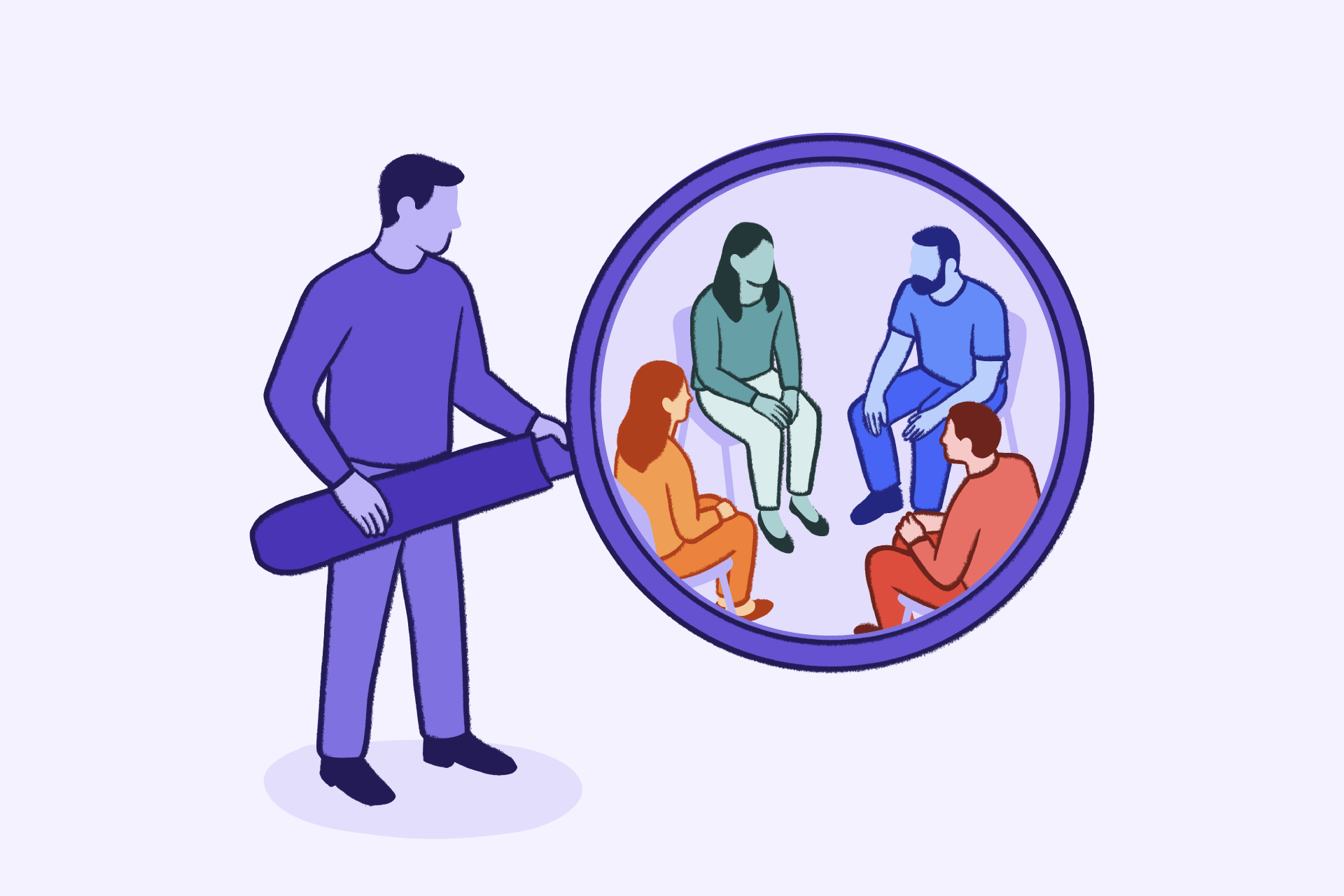
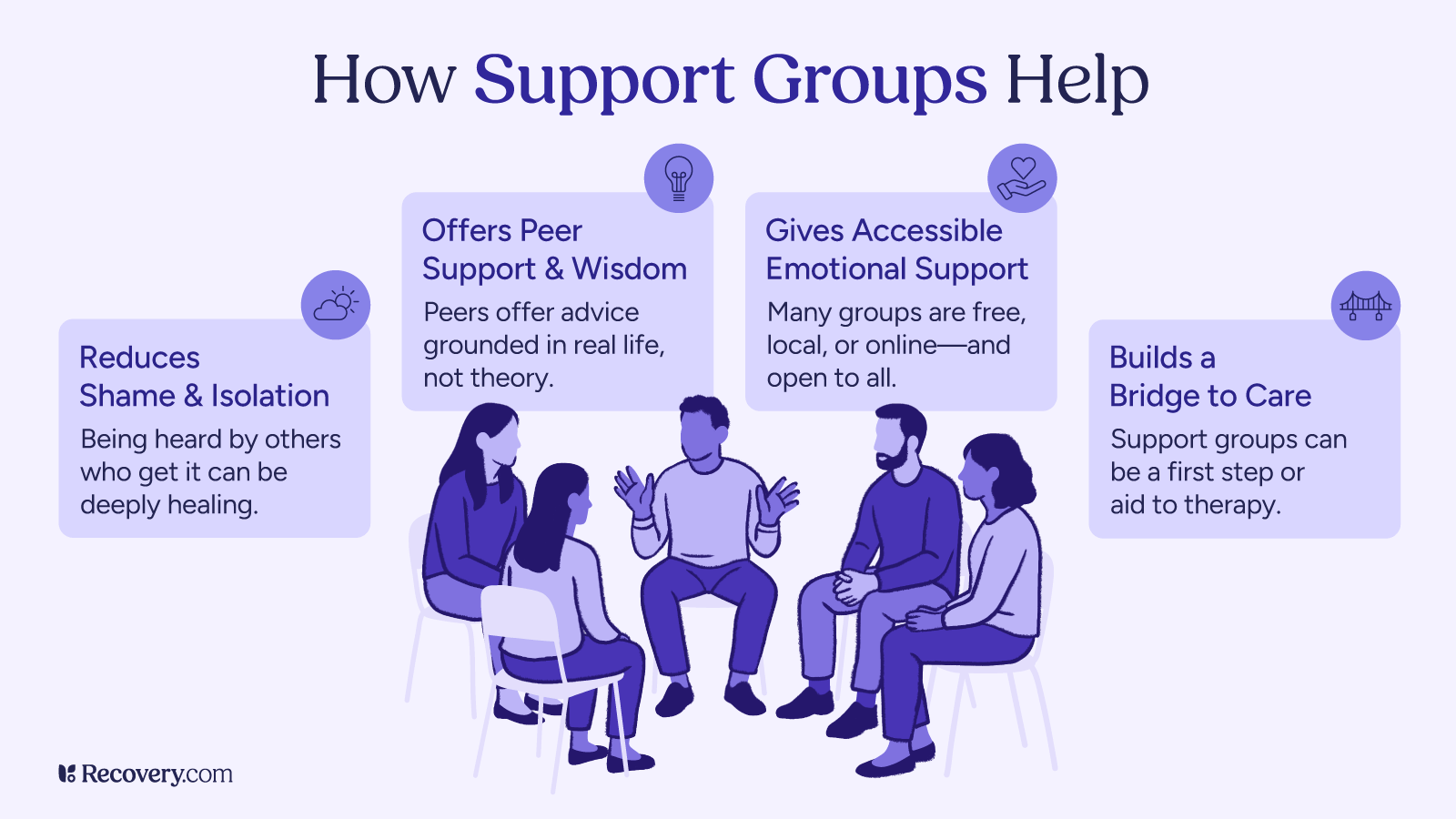
Support groups offer connection and community for people looking for help with mental health and addiction. But with so many options, where do you begin?
In this guide, we share a list of helpful meeting finders that include support groups beyond 12-step fellowships (e.g., AA and NA). You’ll learn how to find the right group to meet your needs.
Top Meeting Finders
The following is a list of reputable resources and meeting finders for support. There are options for a wide range of groups, including alternatives to 12-Step recovery meetings.
If you don’t find what you’re looking for on this list, Recovery.com offers additional options for mental health and addiction treatment.
- Adult Children of Alcoholics & Dysfunctional Families:
Offers support group meetings for adults raised in homes with alcoholism, neglect, or dysfunction. - Alcoholics Anonymous:
Helps individuals find local and online AA meetings focused on recovery from alcohol addiction. - American Foundation for Suicide Prevention’s LGBTQ+ Crisis and Support Resources:
Offers a curated list of crisis lines, peer support networks, and mental health resources specifically for LGBTQ+ individuals seeking help, safety, and community. - Anxiety and Depression Association of America:
Provides a peer-to-peer support group directory for people living with anxiety, depression, OCD, and related conditions. - Celebrate Recovery:
Helps people through a faith-based recovery program with group meetings for addiction, trauma, and co-occurring issues. - Depression and Bipolar Support Alliance:
Offers peer-led support groups across the U.S. for individuals living with mood disorders like depression and bipolar disorder.
Explore Alcohol Treatment Centers
- Eating Disorders Anonymous:
Provides a list of eating disorder meetings that support recovery and healing through a 12-step framework. - Gamblers Anonymous:
Provides an international meeting locator for individuals seeking recovery from gambling addiction. - Grief Recovery After a Substance Passing (GRASP):
Offers community-based support groups for people who have lost a loved one to substance use. - Life Recovery:
Provides a Christian-based support group model that integrates the 12 steps with biblical principles to help people find healing from addiction and life struggles. - Mental Health America:
Includes a wide range of peer-led support groups organized by mental health condition, identity, or life stage. - NAMI (National Alliance on Mental Illness):
Provides free, peer-led support groups for people living with mental illness and their family members. - Narcotics Anonymous:
Offers an international meeting search for individuals recovering from narcotic and drug addiction. - She Recovers:
Shares trauma-informed support for women and nonbinary individuals recovering from substance use, mental health challenges, and life transitions. - SMART Recovery:
Hosts science-based, self-empowering support meetings for recovery from all types of addictive behaviors. - White Bison:
Offers culturally grounded healing programs and peer-led support groups rooted in Native American traditions, including the Wellbriety Movement, to support recovery from addiction and intergenerational trauma. - Women for Sobriety:
Provides mutual support groups for women seeking recovery from substance use through a positive, empowerment-based approach.
Types of Support Groups
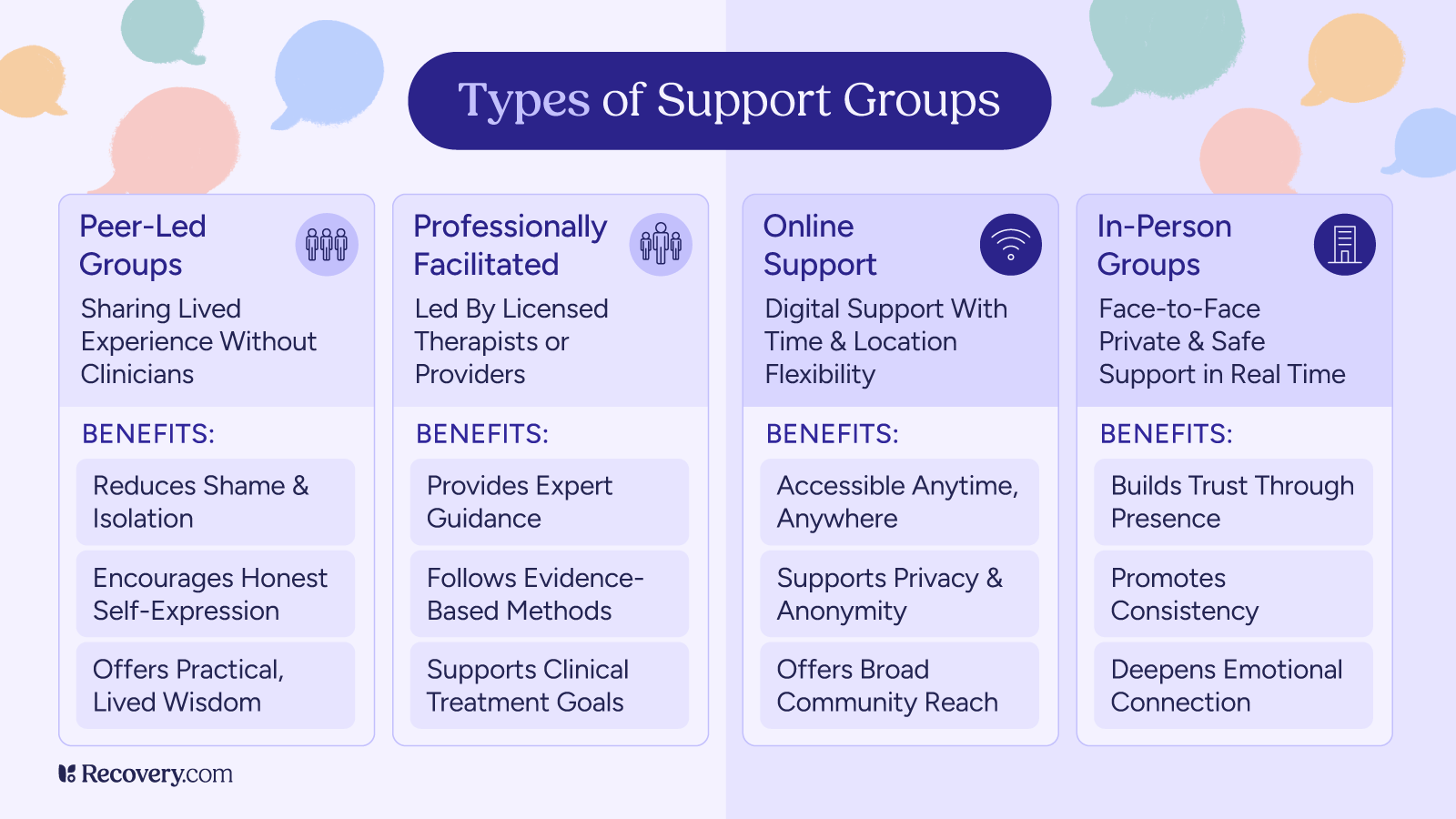
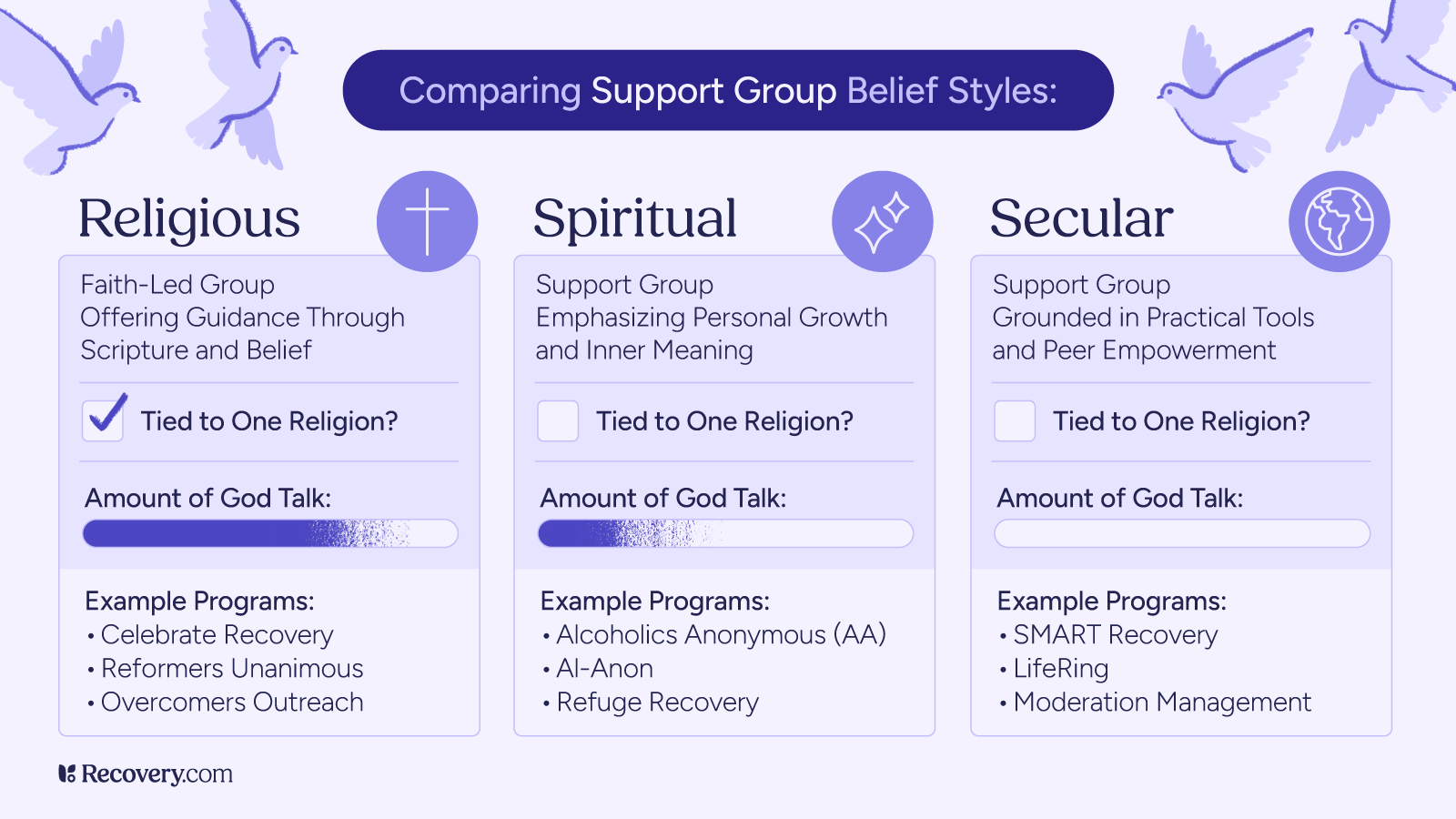
Not all groups are the same. Some occur during inpatient or outpatient treatment and others can occur in community-based settings with non-profit organizations, faith-based groups, and other resources. Here’s how to distinguish between your options.
Ask Your Mental Health Provider
If you’re already connected with a mental health professional, they can recommend groups that align with your diagnosis or treatment plan. Providers often know which support services are active, trustworthy, and appropriate for your stage of healing.
Recovery.com is a great place to find a mental health provider or a higher level of care.
What to Expect in Your First Group Meeting
It’s normal to feel nervous at your first session. Knowing what to expect can ease anxiety. Each group can be different, but there are generally similar things to expect in support groups.
- Sharing is optional: You may be invited to share, but you can always pass. You also don’t have “perform” or present a perfect version of yourself. You can be sad, sit in silence, or simply pass and not share. All feelings and types of shares are welcome.
- A safe space: Groups should maintain confidentiality and respect, and it’s essential to note that group trust often develops over time. It’s normal for a group to be quiet or feel awkward at first. The natural rhythm of the group and the relationships with other group members will strengthen as time passes.
- Not therapy: Peer groups are for sharing and listening—not diagnosing or treating. There’s no pressure to fix or solve anything. The group is about being together and honest connection, not providing solutions to everyone’s problems.
- Facilitators set the tone: Peer or professional facilitators guide the discussion and ensure emotional safety.
- You’re not alone: Most participants are new or have felt nervous, too. Remember, trust builds over time. You can give a group a chance to see if it’s the right fit for you. Or you can try other groups to see if you might feel more comfortable in a different style of gathering or setting.
It’s important to remember that different support groups offer different things. Keep looking for the right group if the first group you try does not fit your needs or what you are looking for. Support groups can be a powerful part of recovery, but finding the right fit may take time.
Try attending more than one group before deciding what works for you. Show up regularly to build trust and connection. Respect others’ boundaries and confidentiality, and be honest without pressuring yourself to share before you’re ready.
Take in what’s helpful, and leave behind what doesn’t serve you.

Support from Social Media and Online Communities
Social media and online peer support communities1 can offer valuable support and empowerment for mental health, but their effectiveness depends on a number of factors like the quality, organizational affiliation, and strength of moderation of the specific platform.
Being selective about where and how you participate ensures a safer, more supportive experience.
While platforms like Meta or Reddit can be valuable sources of peer connection, they vary in quality and moderation. There is also the risk of misinformation2 or bad actors. Look for groups affiliated with a known organization or those with clear group rules and active moderators.
Find Your Place of Belonging
Support groups remind us that healing doesn’t happen in isolation. Whether you’re the one looking for help or you are the person holding space for a loved one, there’s strength in finding people who’ve been there too.
You don’t have to have the right words or be in the perfect place emotionally. Just showing up is enough. The path forward may not be linear, but in community, you don’t have to walk it alone.
Let Recovery.com help you take the next step.
Browse our resources, compare options, and find the support group that brings you back to connection, clarity, and care. You can also compare treatment options near you.
FAQs
-
Rayland, A., & Andrews, J. (2023). From Social Network to Peer Support Network: Opportunities to Explore Mechanisms of Online Peer Support for Mental Health. JMIR mental health, 10, e41855. https://doi.org/10.2196/41855
-
Naslund, J. A., Aschbrenner, K. A., Marsch, L. A., & Bartels, S. J. (2016). The future of mental health care: peer-to-peer support and social media. Epidemiology and psychiatric sciences, 25(2), 113–122. https://doi.org/10.1017/S2045796015001067















Our Promise
How Is Recovery.com Different?
We believe everyone deserves access to accurate, unbiased information about mental health and recovery. That's why we have a comprehensive set of treatment providers and don't charge for inclusion. Any center that meets our criteria can list for free. We do not and have never accepted fees for referring someone to a particular center. Providers who advertise with us must be verified by our Research Team and we clearly mark their status as advertisers.
Our goal is to help you choose the best path for your recovery. That begins with information you can trust.