- Addiction
- Mental Health
- About Us
Find Treatment By
Rehabs by Location


Find Treatment By
Learn
About Us
Recovery.com combines independent research with expert guidance on addiction and mental health treatment. Our mission is to help everyone find the best path to recovery through the most comprehensive, helpful network of treatment providers worldwide.
Advisory Council
Our advisory council brings together leaders in behavioral health, technology, and business. Their diverse expertise ensures our resources and product are innovative, evidence-based, and effective. They guide our mission as accomplished individuals dedicated to improving the landscape of addiction recovery and mental wellness.
What Are Designer Drugs?

As a Clinical Research Specialist, writer, and person with lived experience in mental health recovery, Grace blends clinical research with honest storytelling to inspire healing and hope. In her free time, she enjoys writing books for young adults, an age when she needed stories the most.

Dr. Mala, is the Chief Clinical Officer at Recovery.com, where she develops impartial and informative resources for people seeking addiction and mental health treatment.
As a Clinical Research Specialist, writer, and person with lived experience in mental health recovery, Grace blends clinical research with honest storytelling to inspire healing and hope. In her free time, she enjoys writing books for young adults, an age when she needed stories the most.
Dr. Mala, is the Chief Clinical Officer at Recovery.com, where she develops impartial and informative resources for people seeking addiction and mental health treatment.
- Designer drugs mimic other non-synthetic drugs.
- They typically don't show up on toxicology scans.
- Scientists adapt designer drugs to avoid the law and reach new markets.
Designer drugs are synthetic drugs created to mimic traditional drugs. They sell through gray areas in drug legislations—and can adapt as quickly as legislations change. For those reasons, they’re sometimes called “legal highs”.
Designer drugs carry risks health professionals and law enforcement haven’t fully realized yet. And designer drugs can evolve and change with relative ease, making all the types and variants hard to keep track of.
But for each new designer drug, a way to heal exists. For example, you can go to rehab for designer drug use.
Explore Drug Addiction Treatment Centers
What Exactly Is a Designer Drug?
Here, designer doesn’t mean fancy. The “designer” class of drugs just means someone designed the drug to act in a certain way.1 It also means it was designed to skirt the law through cracks in controlled substance legislations.
They’re sold in packaging that says they’re “not for human consumption,” which can keep their manufacturers somewhat safe from legal trouble.
Some designer drugs began as a research project.2 Shady scientists can hijack the research made on the brain and tailor a drug to have a particular reaction. Designer drugs originated overseas, produced in places like China and Europe before shipping to America.
Young teens and military members use designer drugs more often since they don’t always appear in drug tests.1 The packaging and names of designer drugs also cater to young teens, with bright colors, fun designs, and names like Green Giant and Joker.
Are Designer Drugs The Same As Synthetic Drugs?
Synthetic drugs don’t always have illegal connotations, as designer drugs do. For example, morphine is a synthetic drug. Though someone could abuse it, morphine wasn’t designed, manufactured, and sold with that in mind.
Designer drugs specifically mimic other illegal drugs—but with chemical properties most toxicology screens won’t notice. Chemicals like fentanyl, morphine, and LSD would show.
And like any other drug, natural or synthetic, designer drugs come with a unique set of risks and side effects.
Common Risks And Side Effects of Designer Drug Use
No drug is without risk. But for designer drugs, their sneaky manufacturing and profit-motivated sellers create problems we’re yet to fully understand.
For example, most designer drug users don’t take just one.2 They may combine 2 or more designer stimulants, or make a speedball with a depressant and stimulant. The process of making designer drugs hasn’t been regulated in any way either, meaning you could take a much higher dose than intended or something you never meant to take.
The general side effects of designer drug use include3
- Serotonin syndrome
- Seizures
- Hyperthermia
- Psychosis
- Insomnia
- Paranoia
- Hypertension
- Heart attack
- Kidney failure
- Tachycardia
The more precise effects of designer drugs vary based on the kind you take.
The 7 Different Types of Designer Drugs
The U.S. Drug Enforcement Administration (DEA) recognizes 7 different kinds of designer drugs.4 They might add more in the future, but for now, these 7 are what they’ve been able to identify.
Synthetic Cannabinoids
Most synthetic cannabinoids began as an innocent research project.5 Synthetic cannabinoids affect receptors throughout the body in the same way as THC (found in marijuana). It creates an elevated mood and sense of relaxation.5 Almost all synthetic cannabinoids go by the street name Spice.
Compared to natural marijuana, Spice usually has a stronger effect and higher potential for toxicity.5
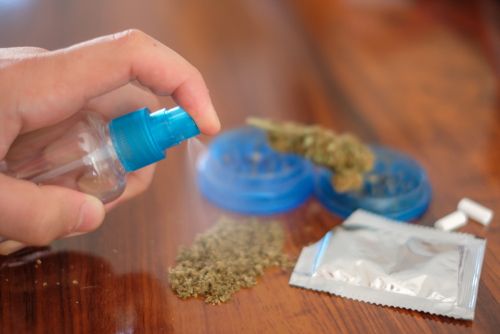
The chemical compound of Spice coats plant material, making it look like marijuana. You can smoke Spice like regular weed, snort it, or eat it. Its side effects include acute psychosis, anxiety, tachycardia, confusion, paranoia, and delusions.
Phenethylamines
Phenethylamines are synthetic hallucinogens, called 2Cs for their 2 connecting carbon molecules.6 Other street names include N-Bomb, based on the chemical name 25I-NBOMe. They communicate with serotonin receptors in the brain.7
Phenethylamines recently hit the U.S. market after they were made to research serotonin receptors.7 You can snort, smoke, inject, or swallow N-Bomb as a liquid or powder. After use, side effects like depersonalization, delirium, extreme confusion, violence, tachycardia, hyperreflexia, bizarre behavior, and heart failure can occur.
Arylcyclohexylamines
Arylcyclohexylamines cause a dissociative high. The drug compounds of arylcyclohexylamines include ketamine, phencyclidines (PCP), and more.8 PCP goes by the street name “angel dust” as it’s typically “dusted” over marijuana and tobacco before smoking. Many synthetic arylcyclohexylamines were originally designed as anesthetics. PCP began that way too, before retiring to a veterinary anesthetic for its side effects.
Ketamine isn’t as strong as PCP but still has addictive potential, especially at higher doses. Smaller doses, however, can be therapeutic.
These designer drugs can cause violent behavior, hallucinations, amnesia, coma, ataxia, catatonia, and tachycardia.
Tryptamines
Everyone has naturally occurring tryptamines—serotonin, melatonin, and others. But synthetic tryptamines act as hallucinogens.9 They typically mimic the effects of LSD and DMT (psychedelic found in plants and animals). Street names include “Foxy”, “Foxy-Methoxy”, “Alpha-O”, and “5-MEO”.
Tryptamines cause hallucinations and some stimulant effects9. They can also cause agitation, muscle tension, death, and rhabdomyolysis. Designer tryptamines come as pills, capsules, powders, or a liquid.
Piperazines
Piperazines cause many of the same effects as ecstasy, a stimulant. Similar to ecstasy, they’re marketed toward party-goers and even created to look like ecstasy.10 Its slang names include “party pills”, “Jax”, “Legal E”, “Flying Angel”, and “Pep X”.
Piperazines gained popularity worldwide as a mislabeled legal alternative to meth and MDMA (ecstasy).10 There’s little regulation or control over piperazines, making them an especially risky designer drug.
After taking piperazines, which come as a pill or powder, you might experience seizures, hallucinations, kidney failure, and respiratory acidosis.
Pipradrol
Pipradrol, a stimulant, was first used as an antidepressant.11 It was also used to treat dementia and obesity. But pipradrol was quickly recalled due to its potential for abuse. Its effects mirror amphetamines—without some of the undesirable side effects. Pipradrols suppress appetite and don’t cause noticeable overexcitement, like other stimulants.
Pipradrol’s street names include MRD-108 and Alpha. Its toxic effects include hallucinations, death, anxiety, nausea, and convulsions.
Cathinones
Cathinones mimic cocaine, ecstasy, and MDMA as designer central nervous system stimulant.12 They’re commonly called bath salts and cause a sense of euphoria. Being marketed as a designer drug, you can find bath salts online, in gas stations, smoke shops, and adult stores.
Other street names include “Bliss,” “Blue Silk,” “Glass Cleaner,” and “Super Coke.” The active ingredient in cathinone comes from a khat plant. Scientists synthesized a drug based on the khat plant to form bath salts, which look like small, opaque rocks. Taking bath salts can cause psychosis, confusion, violence, hypertension, seizures, death, paranoia, and delusions.
The makers of designer drugs suggest they’re a fun alternative to “real” drugs. Or, a way to take drugs without getting caught—or without accidentally hurting yourself.
But neither proves true.
Are Designer Drugs Addictive?
Yes. Some designer drugs could be even more addictive than the drug they’re copying. Fentanyl, for example, mimics natural opioids like heroin—but it’s 50 times more potent.13
Most designer drugs are supposed to be addictive.1 What begins as an experiment or coping tool can spiral out of control and into addiction. Because, with the easier accessibility of designer drugs, feeding the habit isn’t too difficult. Finding a reason to stop could feel unnecessary.
But you can.
Getting Help for Designer Drug Use
Designer drug addiction often responds well to the same treatments used for natural drug addictions. Some benzodiazepines can help with long-term treatment and withdrawal.1
Some patients confront their need for treatment in an emergency room. An ER can get you stabilized and ready for the next steps in treatment, like a residential rehab with 24/7 support.
In treatment, you’ll likely have group and individual therapy to address the thoughts and behaviors behind your addiction. You might also join 12 Step meetings, which encourage you to find support in your higher power and in your peers. Many rehabs take insurance to make the cost of care more affordable. And your family can heal with you too, sincemost rehabs also offer family services.
Treatment for designer drug use has the potential to unlock a life of recovery. To learn more about your recovery resources, you can browse our list of rehabs with reviews, pricing, insurance information, and photos.
Get Help For Yourself or A Loved One Today
Recovery may seem daunting, but effective help is available. Explore residential drug rehabs or specialized alcohol addiction treatment programs to find the right environment for healing. Use our free tool to search for addiction treatment by insurance, location, and amenities now.
FAQs
-
Weaver, M. F., Hopper, J. A., & Gunderson, E. W. (2015). Designer drugs 2015: Assessment and management. Addiction Science & Clinical Practice, 10(1), 8. https://doi.org/10.1186/s13722-015-0024-7
-
Fratantonio, J., Andrade, L., & Febo, M. (2015). Designer drugs: A synthetic catastrophe. Journal of Reward Deficiency Syndrome, 1(2), 82–86. https://doi.org/10.17756/jrds.2015-014
-
Liechti, M. (2014). Novel psychoactive substances (Designer drugs): Overview and pharmacology of modulators of monoamine signalling. Swiss Medical Weekly, 144(0304), w14043–w14043. https://doi.org/10.4414/smw.2015.14043
-
Designer drugs | dea. Gov. (n.d.). Retrieved May 5, 2023, from https://www.dea.gov/taxonomy/term/341
-
Abuse, N. I. on D. (2018, February 5). Synthetic cannabinoids (K2/spice) drugfacts. National Institute on Drug Abuse. https://nida.nih.gov/publications/drugfacts/synthetic-cannabinoids-k2spice
-
Phencyclidine—An overview | sciencedirect topics. (n.d.). Retrieved May 5, 2023, from https://www.sciencedirect.com/topics/pharmacology-toxicology-and-pharmaceutical-science/phencyclidine#:~:text=Phencyclidine%20(PCP)%20is%20one%20of,dizocilpine%20(MK%2D801).
-
Luethi, D., & Liechti, M. E. (2020). Designer drugs: Mechanism of action and adverse effects. Archives of Toxicology, 94(4), 1085–1133. https://doi.org/10.1007/s00204-020-02693-7
-
Details for tryptamines. (n.d.). Retrieved May 5, 2023, from https://www.unodc.org/LSS/SubstanceGroup/Details/68c027b6-0ed9-4c07-a139-7f1ca7ffce84#:~:text=Tryptamines%20act%20predominantly%20as%20hallucinogens,also%20possess%20residual%20stimulant%20activity.
-
Details for piperazines. (n.d.). Retrieved May 22, 2023, from https://www.unodc.org/LSS/SubstanceGroup/Details/8242b801-355c-4454-9fdc-ba4b7e7689d5
-
Pipradrol. (n.d.). Retrieved May 5, 2023, from https://go.drugbank.com/drugs/DB11584
-
Bath Salts—DEA Fact Sheet. (2020). Drug Enforcement Administration. https://www.dea.gov/sites/default/files/2020-06/Bath%20Salts-2020.pdf
-
Gregg, R. A., & Rawls, S. M. (2014). Behavioral pharmacology of designer cathinones: a review of the preclinical literature. Life sciences, 97(1), 27–30. https://doi.org/10.1016/j.lfs.2013.10.033














Our Promise
How Is Recovery.com Different?
We believe everyone deserves access to accurate, unbiased information about mental health and recovery. That's why we have a comprehensive set of treatment providers and don't charge for inclusion. Any center that meets our criteria can list for free. We do not and have never accepted fees for referring someone to a particular center. Providers who advertise with us must be verified by our Research Team and we clearly mark their status as advertisers.
Our goal is to help you choose the best path for your recovery. That begins with information you can trust.